2026-10-30
Acne Scar Treatment: 3 Things to Decide Before Laser Intensity (Treatment Diary ①)
A Seoul plastic surgeon explains how to assess acne scar structure before choosing laser intensity, and why UltraPulse Alpha was used for a patient’s first session.

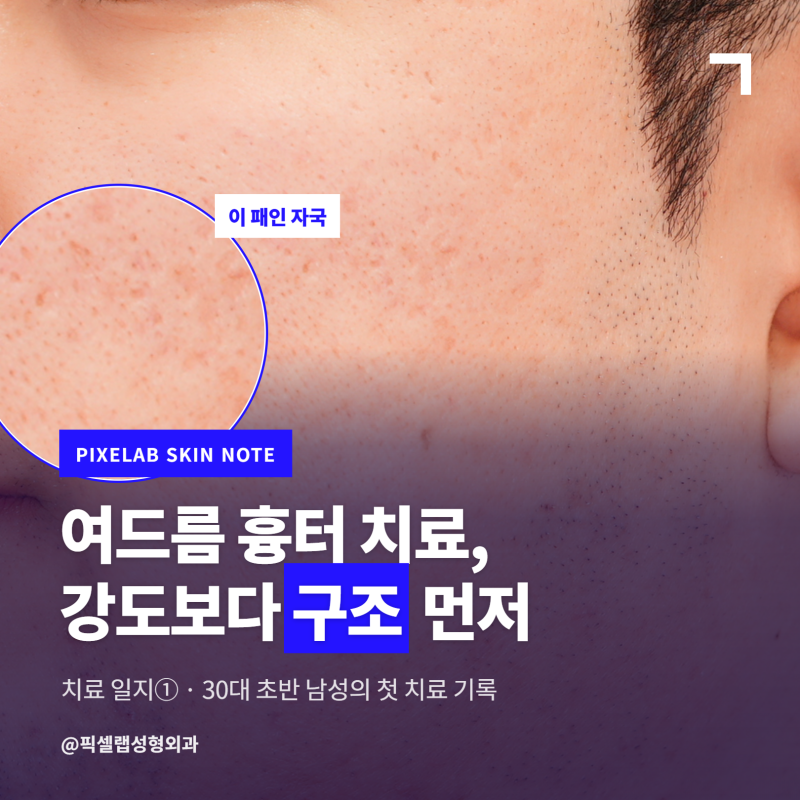
Have you ever noticed how the shadows on your cheeks look especially pronounced when you stand under overhead lighting, like in an elevator?
In acne scar treatment, the first thing to assess is not the laser intensity but the “structure of the scar.”
If you simply increase the intensity without considering the scar’s depth, borders, and adhesions, you only add to the burden of recovery.
Hello,
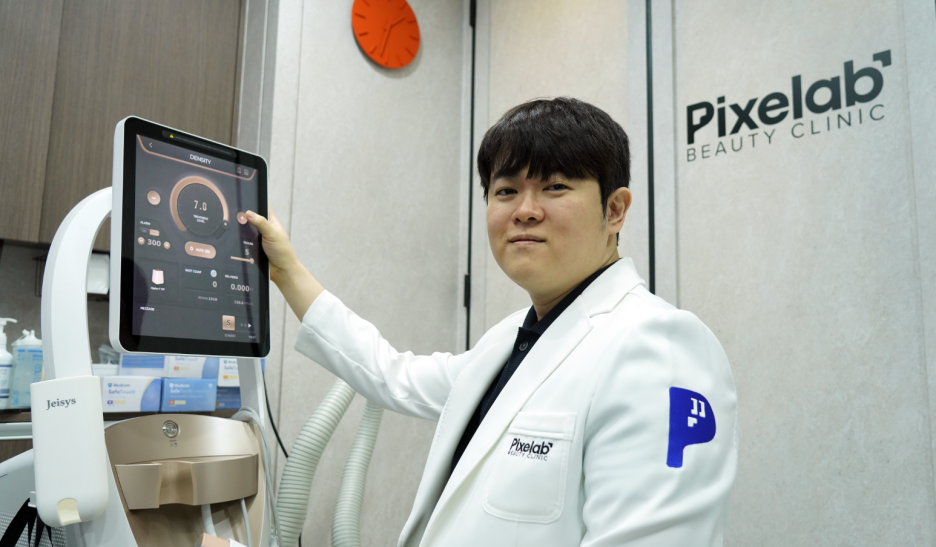
I am Jong-geun Song, Director of Pixellab Plastic Surgery Clinic in Sinnonhyeon.
In August 2025, at the Lumenis Unveil event,
I was selected as an “UltraPulse Alpha Visionary.”
Since then, I have continued
discussing the future direction of this device with Lumenis.
That same year, in November,
I attended a small bootcamp held in Milan, Italy,
hosted by Lumenis headquarters.
Only four medical professionals from Korea were invited to this session,
and together with leading physicians from around the world,
we closely examined the settings and parameters for acne scar treatment
and discussed them in depth.
Today’s post documents the first treatment of a man in his early 30s
whom I personally consulted with and treated.
I will walk you through, in order,
how I read the structure of the scars
and why I chose UltraPulse Alpha.
Photos are included with the patient’s consent.
Treatment responses vary from person to person.
1. Isn’t acne scar treatment about more than filling in holes?
In consultations, many people describe their scars
as “pitted holes.”
However, how prominent a scar appears
depends as much on the slope of its edges
as on the depth of its floor.
That is why I always consider the depth of the floor
together with the steepness of the edges.
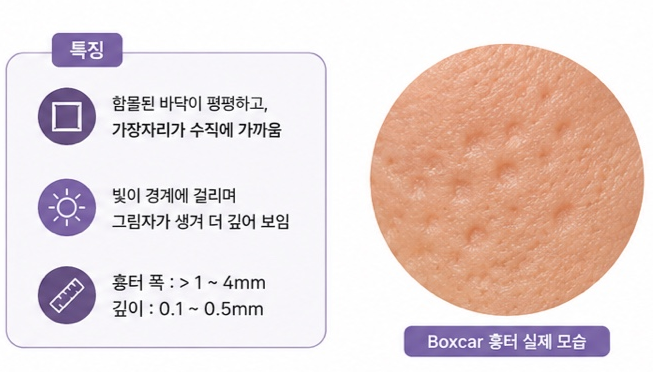
Boxcar scars have sharply defined borders
between the surrounding skin and the depressed area.
Even if the floor is raised to some extent,
when the edges remain steep, light catches on the border and the shadow stays.
This is what I tell my patients:
Lifting the floor alone is not enough. The edge angle must also be softened so the scar looks less sunken under lighting.
2. What Structural Factors Do I Discuss First in Acne Scar Consultations?
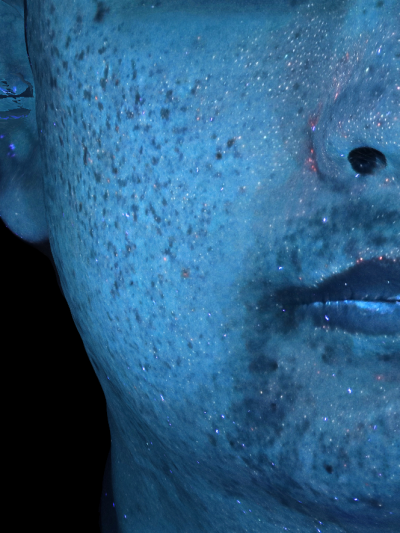
The same cheek in a UV skin-analysis photo, where many dark spots and dots stand out across the skin.
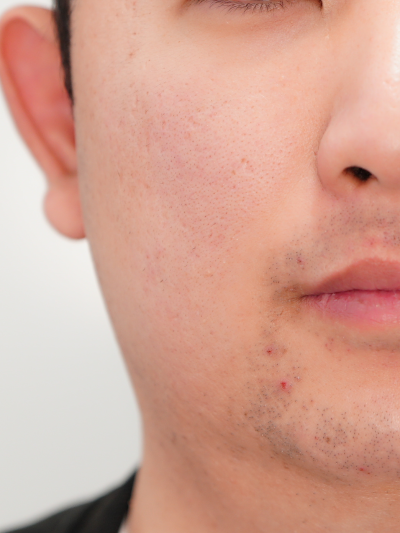
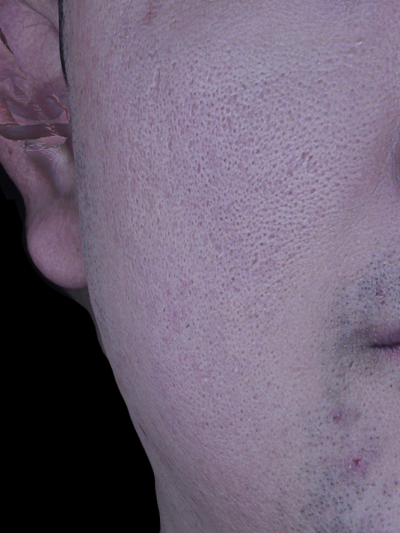
Close-up of the man's cheek and jaw in normal light, showing uneven skin texture and a few red spots near the chin.
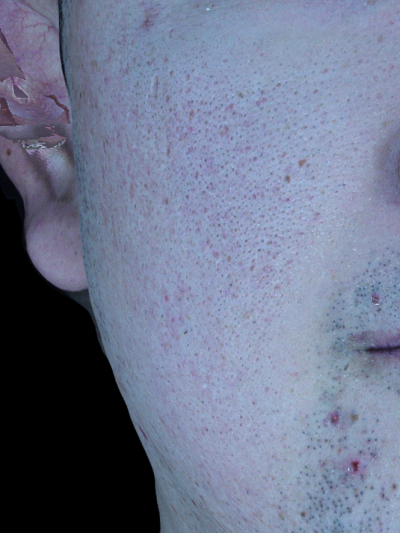
A further analysis view of the same area, bringing out red spots and redness scattered over the cheek.
Another skin-analysis view of the same area that highlights pores and the uneven surface texture.
The skin information you can see
differs depending on the photography method.
|
Even on the same skin, each photography method highlights
different information,
so it is important to
analyze the results of multiple methods together.
This patient had large and small depressions
spreading widely across both cheeks.
Under general lighting, enlarged pores
and overall skin texture stood out first,
while under SL photography, the uneven
skin surface and texture differences on both cheeks
were observed more clearly.
PL and UV photography were used to check
redness and pigmentation around the scars,
and sebum levels.
The location and shape of the depressions
were determined by combining side-profile photos, 3D images,
and my own clinical observations.
Across the front cheeks and below the cheekbones, boxcar-type
atrophic scars with well-defined edges were widely distributed,
and between them, rolling-type undulations with gentle borders
were mixed in.
Enlarged pores were found beside the nose and on the front cheeks,
while on the chin and around the mouth,
a few inflammatory lesions and red marks remained.
Active inflammation had not
spread across the entire face.
Therefore, I did not postpone treatment,
but instead avoided areas with active inflammation
or adjusted the settings separately.
My diagnosis was
“moderate mixed-type atrophic acne scarring.”
Boxcar scars were the main type,
mixed with rolling undulations and enlarged pores.
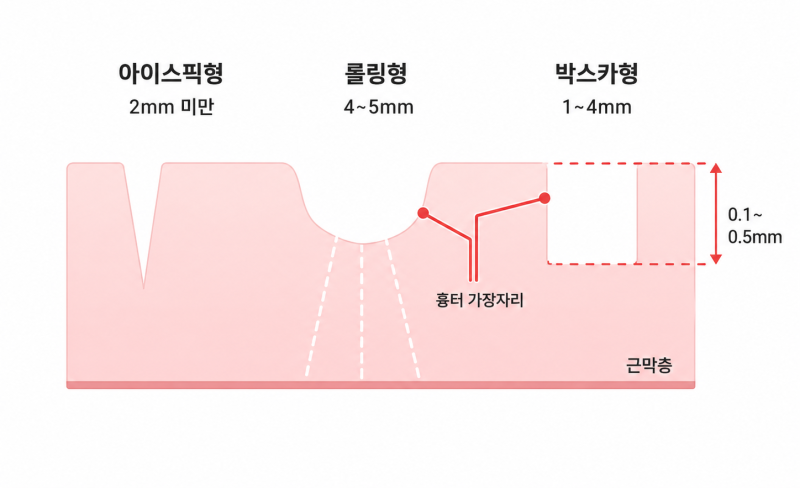
Scar types: icepick (under 2 mm), rolling (4–5 mm) and boxcar (1–4 mm wide, 0.1–0.5 mm deep), with scar edges and fascia layer labeled.
Type | Visible features | Focus point |
Boxcar | Well-defined borders and steep walls | Edge angle |
Rolling | Broad area sinks in a wave-like pattern | Presence of underlying adhesions |
Ice pick | Narrow and deep, like a point | Need for targeted treatment |
Enlarged pores | Rough-looking surface texture | Extent of surface resurfacing |
When scars of different shapes are mixed together,
a single fractional CO2 laser mode
is difficult to manage effectively.
This point is also discussed
in a 2025 study
published in Lasers in Medical Science.
Source: Jin W, Jin Q, Nan M, et al. Lasers in Medical Science. 2025;40:345.
3. Why Did I Treat the Entire Face, Not Just the Visible Scars?
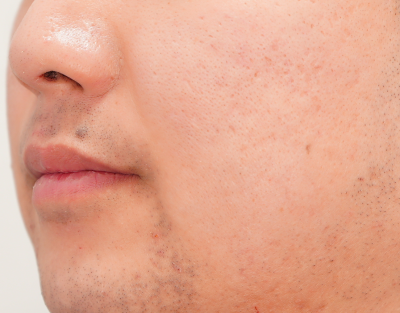
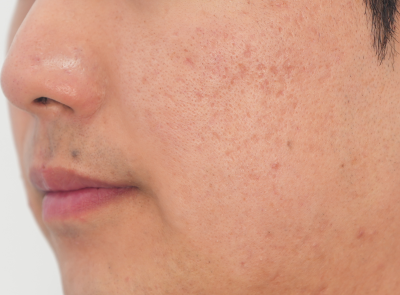
Another side view of the cheek, with clusters of red spots and pitted marks across the skin.
Side view of the man's cheek, showing small pitted marks and light redness on the skin.
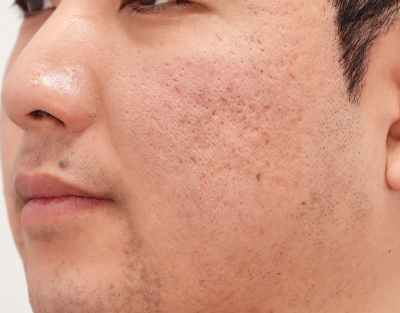
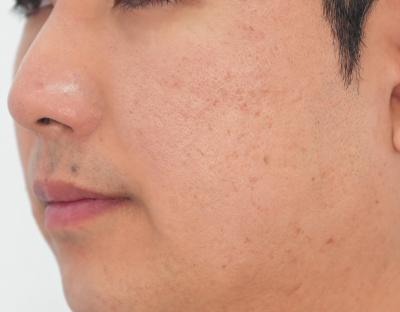
Another three-quarter view of the same cheek, showing scattered marks and the skin texture.
Three-quarter view of the man's face, with red spots and pitted scars visible across the cheek.
The reason this patient’s skin looked rough
was not one or two deep scars.
Shallow depressions and boxcar-type borders
repeated across both cheeks,
and the shadows continued without interruption.
If you aggressively treat only a few conspicuous spots,
those spots alone develop a different texture
and can actually look even more noticeable.
That is why I treated the entire face from the very first session.
Instead, I did not apply the same
settings to every area.
For areas with concentrated scars, I focused on depth;
for areas where skin texture and pores were the concern,
I prioritized surface resurfacing and split the settings accordingly.
4. Why Did I Choose UltraPulse Alpha for Acne Scar Treatment?
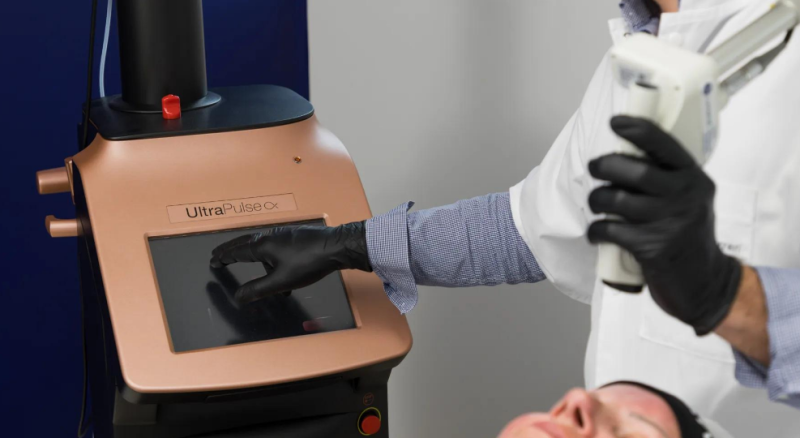
A gloved practitioner taps the UltraPulse laser's touchscreen while holding the handpiece over a reclining patient.
UltraPulse Alpha is
a CO2 laser with a 10,600 nm wavelength.
This wavelength is well absorbed by water in the skin,
balancing the effect of finely ablating the surface
with the effect of delivering heat to the dermis.
The main reasons I chose this device
come down to three points.
The first is pulsing.
It delivers energy in very short bursts,
designed to reduce residual heat in the surrounding tissue.
Because heat spreads less,
the stress on normal tissue beside the scar can also be reduced.
Second,
the DeepFX and SCAARFX modes let you change
the depth layer targeted to match each scar’s depth.
In rolling scars,
firm adhesions (fibrotic bands) beneath the skin
often pull the surface downward,
so these areas are treated down to deeper layers
to release the adhesions.
Shallow scars and skin texture are treated at shallower layers.
Even within the same face, the depth
can be varied scar by scar through layered treatment,
meaning that customized combination treatment is possible.
Third, with the 1.3 mm CPG scanner,
surface resurfacing can be performed separately.
When the “step” left at the scar border is smoothed with CPG,
the edges become gentler (border softening).
Because less shadow forms even under light,
an optical illusion effect is expected, making the scar look less sunken.
It is also used to even out
surface irregularities, pores, and fine wrinkle texture.
Deep areas are lifted with DeepFX,
and the surface is refined with CPG.
Of course, a good device does not
automatically guarantee results.
Scar depth, skin thickness, pore and sebum condition,
and even whether the skin is prone to pigmentation must all be considered.
This is why depth and density must differ from patient to patient.
5. What Was the Order of the First Treatment?
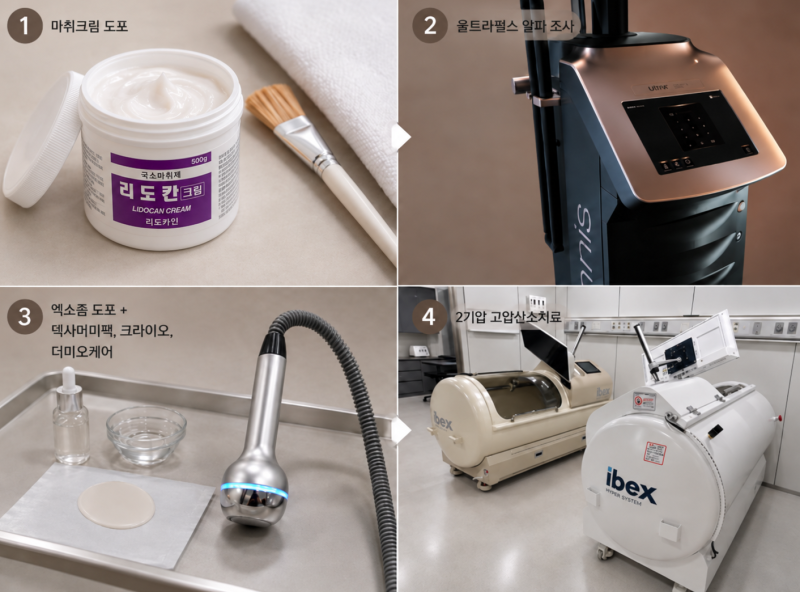
The first treatment took place on February 10, 2026.
After applying numbing cream and waiting 30 minutes,
UltraPulse Alpha was delivered across the entire face.
After the laser, exosome was applied,
followed by Dexa Mummy Pack and cryo treatment,
Dummi Care, and hyperbaric oxygen therapy,
and finally a DuoDERM dressing was applied.
Hyperbaric oxygen chambers can reach up to 3 atmospheres,
but for patients who are not accustomed to high-pressure environments,
we adjust the pressure.
This patient was treated at 2 atmospheres.
In the first session, the entire face was treated only once.
To understand how quickly this skin recovers,
we needed to determine how many passes and which settings
to use in the next session.
During treatment, fine hairs can touch the laser,
and you may smell something like burning hair.
Patients who know this in advance are less startled.
Pain is felt differently depending on the area and settings.
6. Why Is Aftercare an Essential Part of Acne Scar Treatment?
Fractional CO2 laser intentionally creates
tiny wounds in the skin.
Even with the same treatment, the outcome depends on
the environment in which those wounds heal.
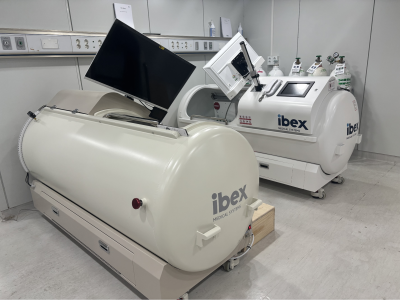
Two ibex hyperbaric oxygen chambers in a treatment room.
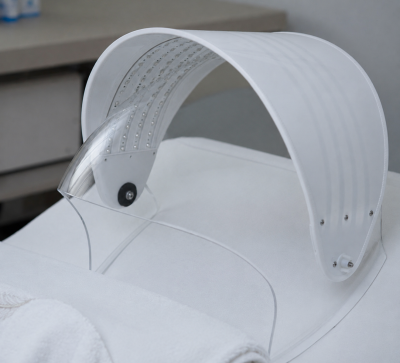
A curved white LED light-therapy panel set over a treatment bed.
Heat and irritation right after treatment
are calmed with Dexa Mummy Pack and cryo treatment.
Dummi Care and hyperbaric oxygen therapy
play a role in supporting the healing environment.
DuoDERM keeps the wound moist, which helps reduce
the formation of thick or cracked scabs.
Oozing may occur on the first day, so dressings
must be changed on time.
We ask you to return on day 3 and at one week,
when we check how long oozing lasted,
whether the redness is subsiding,
and the condition of the scabs, and whether any pigmentation has appeared.
Only when recovery follows the expected course
can we increase the treatment area and number of sessions in the next round.
Conversely, patients with severe active acne,
those with pigmentation-prone skin,
or those who find it difficult to set aside about a week for recovery
are advised to adjust the timing and intensity or start with other treatments first.
◆ Frequently Asked Questions
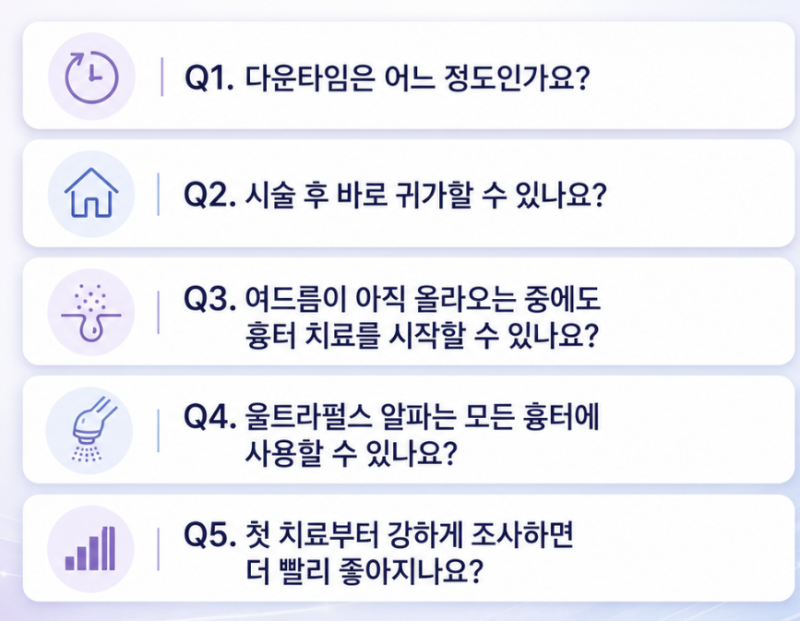
Q1. How long is the downtime?
Redness, warmth, swelling, oozing, and thin scabs
may occur.
At least 3 days, or one week if possible,
is recommended to keep your schedule free.
Recovery speed varies from person to person.
Q2. Can I go home right after the treatment?
Yes, you can go home right away.
Since redness and dressings are noticeable,
it is convenient to bring a mask and a hat.
Q3. Can I get scar treatment while acne keeps flaring up?
Acne scar treatment is safest to start
after active inflammation has been fully calmed.
If scar treatment is added while inflammation persists,
new scars or pigmentation may worsen.
First, we start with calming and regenerative treatments
that help suppress new acne breakouts,
then develop a customized treatment plan
based on the depth and shape of the scars.
Q4. Can UltraPulse Alpha be used on all acne scars?
It is not a cure-all for every scar,
but its range of application is fairly broad.
The difference comes down to energy.
To reach the same depth of 0.6 mm,
a standard fractional CO2 laser requires
40–120 mJ,
whereas UltraPulse Alpha needs only about 15 mJ.
This method is designed to reduce residual heat in the surrounding tissue.
In addition, the SCAARFX mode
can reach a depth of up to about 4 mm,
so it can address shallow boxcar or rolling scars,
as well as deep ice pick scars
and scars with severe dermal adhesions.
Depending on the scar pattern,
different procedures sometimes need to be combined,
so we formulate the treatment plan after an accurate structural assessment.
Q5. Will stronger energy from the first session speed up results?
Simply pushing for higher intensity
does not necessarily lead to better results.
High laser output places a greater burden on the skin,
so individual skin recovery capacity and response must be considered as well.
Delivering excessive energy
increases the burden of recovery,
so after the first session, we check the skin’s regenerative response
and from the next session onward, safely fine-tune the intensity,
which is also better for results.
In Part 2, I will explain the settings for the second and third treatment days
and how I changed them.
I will also show the changes visible in the photos
along with the areas that still remain.



*This post was written directly by Pixellab Plastic Surgery Clinic for the purpose of providing medical information and promotion, in compliance with Article 56(1) of the Medical Service Act. All treatments and surgeries carry the possibility of side effects that vary by individual, so we strongly recommend making decisions only after thorough consultation with qualified medical professionals.