2026-11-04
Does Titanium Lifting Really Not Hurt? 3 Things to Know If You're Worried
Titanium lifting pain isn't completely absent but can be managed. Learn why heat builds up, how energy is adjusted during treatment, and who should postpone.
You may have undergone titanium lifting after being told it was painless, only to lie down and think, “Why is it so hot?”
The short answer is that titanium lifting pain is not completely absent. It is manageable pain.
Below, I’ll explain exactly what I mean by “manageable pain” and the criteria I use to control it in my clinic, one step at a time. If you have a procedure coming up, please read carefully.

Hello,
I am Dr. Song Jong-geun, director of Pixellab Plastic Surgery in Sinnonhyeon.
As a board-certified plastic surgeon, I introduced Alma’s titanium device and have performed a cumulative 10 million shots. I switch modes depending on the treatment area.
The question I hear most often in my clinic is, “Doctor, titanium doesn’t hurt, right?”
Today, I’d like to answer that question honestly.
If you are worried about titanium lifting pain, you only need to check the three points below.
① Does titanium lifting hurt too? — How the pain occurs
② The criteria I use to manage pain in my clinic — What “manageable pain” really means
③ When I don’t recommend this treatment — Situations where it’s better to postpone because of pain
In this post, I’ll go through these three points in order.
1. Does titanium lifting really not hurt?
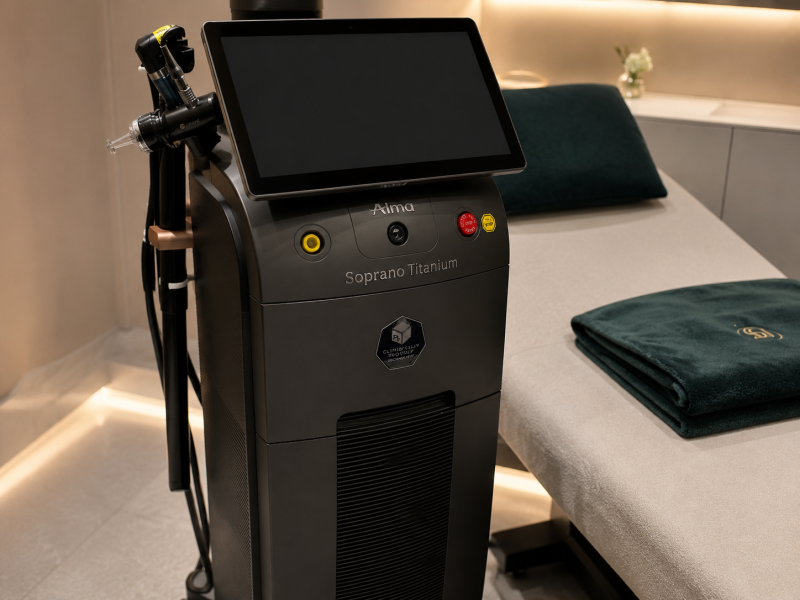
The Alma Soprano Titanium device standing beside a treatment bed in a clinic room.
If you search online, you’ll find many explanations claiming that it doesn’t hurt because sapphire cooling chills the skin surface below freezing.
That explanation is only half right. Let me clarify, since it can be misleading.
When the handpiece (the device placed directly on the skin) first touches the skin, patients often describe the sensation as ice-cold.
It’s true that the sapphire cooling system (the device that chills the surface of the treatment area) protects the skin surface.
However, as treatment progresses and heat builds up beneath the skin, the surface feels cool while the inside feels hot.
Surprisingly, some patients find this sensation painful.
2. So why does it hurt?
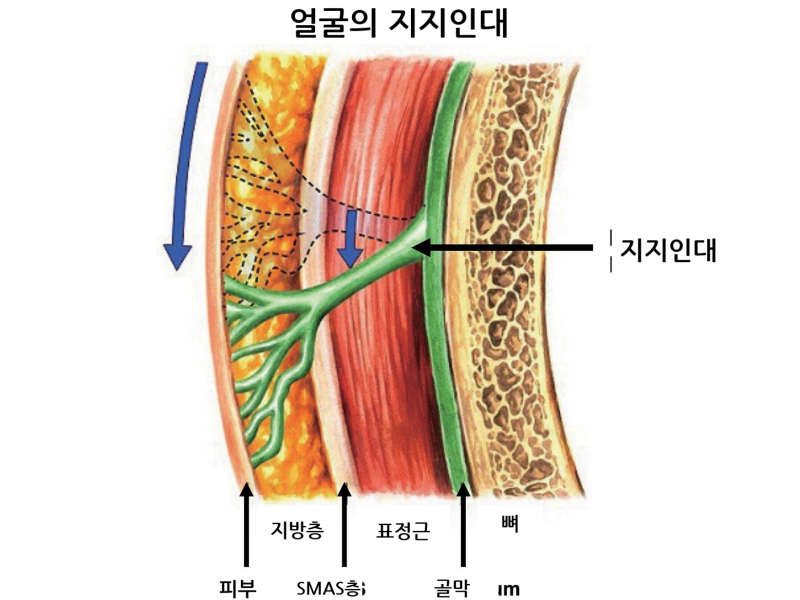
Diagram titled 'Facial retaining ligaments', labeling the skin, fat layer, SMAS layer, facial muscles, periosteum and bone.
Titanium lifting works by combining three wavelengths of light—755, 810, and 1064 nm—to build up heat in the retaining ligaments beneath the skin.
Retaining ligaments are structures that support tissue attached to firm bone, much like a net.
The skin tightens only when heat is delivered to these ligaments.
The catch is that once heat reaches the ligaments, some degree of pain is almost inevitable.
Because the surface feels cool from the cooling device while the inside feels hot, patients who have difficulty tolerating heat often describe the treatment as painful.
This pain is less like a needle prick and more like a warm heat that swells up from deep inside.
I explain to patients that a certain degree of heat may come with the treatment in order to see the results they hope for.
This is because if the energy is lowered too much to avoid discomfort, the results may feel limited.
So for patients who come in expecting zero pain, I make a point of explaining in advance that some degree of heat may be felt, depending on the person.
3. The criteria I use to manage pain in my clinic

Even with the same energy settings, the heat and pain a patient feels during titanium lifting can differ from person to person.
That’s why, rather than eliminating pain at all costs, I continually check the warmth and heat the patient feels during treatment and adjust within the range that still delivers the energy the procedure requires.
If the heat is too weak, the energy may not be delivered as intended. If it becomes too hot to bear, I immediately adjust the energy, the speed, or the treatment area.
Ultimately, what matters is finding the balance between the level of heat a patient can tolerate and the energy needed for the treatment.
To do this, I use three methods during actual treatment.
1. Adjusting energy and speed
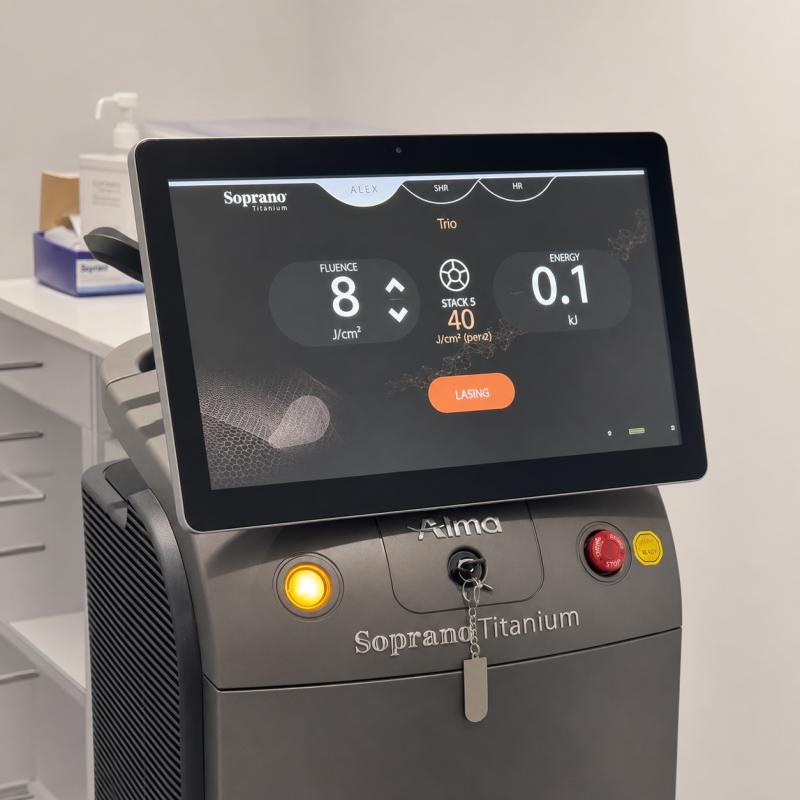
The Soprano Titanium screen in Trio mode, showing fluence 8 J/cm², stack 5 at 40 J/cm² and energy 0.1 kJ.
If it gets too hot, I lower the energy or move the handpiece more quickly. This often reduces discomfort, and depending on the treatment goal, I briefly shift to other areas during the procedure.
2. Designing treatment around each person’s pain sensitivity
For patients who tolerate heat well, there’s no real need to go easy. For those sensitive to pain, I finish more gently. Unless the goal is to be completely pain-free, I safely adjust energy within the range needed.
3. Taping and modes
Depending on the characteristics of each area, I use three modes—Stack, SHR, and Impact—and follow a protocol of thorough taping to reduce the risk of burns.
I always put pain and safety first. The key is delivering energy exactly as planned for each patient’s treatment area.
4. When I don’t recommend titanium lifting

Even if you came in worried about titanium lifting pain, I will suggest postponing the treatment or trying another option first if any of the following apply.
|
Proceeding anyway in these cases may leave you with limited results and heightened stress about pain, which can lower your satisfaction.
5. Frequently asked questions, answered in advance
Q1. What’s the difference between titanium lifting and Ulthera?
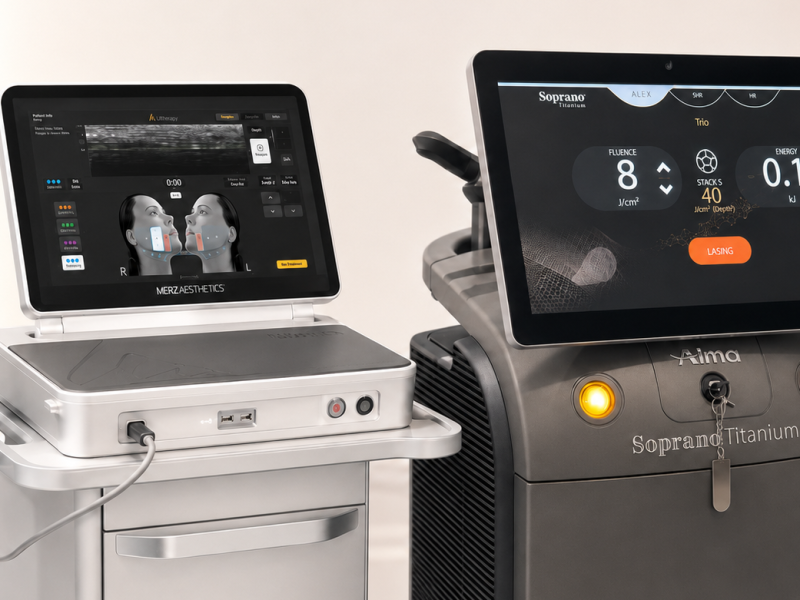
Both treatments tighten the skin by delivering heat to the retaining ligaments, so the underlying principle is the same. However, the way they deliver heat is different.
Category | Titanium Lifting | Ulthera |
Energy type | Three-wavelength laser light | Ultrasound |
Delivery method | Builds heat across a broad area | Focuses heat on a single point |
Pain pattern | Heat that swells from within | A momentary, passing sensation |
Adjustable factors | Cooling, energy, handpiece speed | Depth and number of shots |
Because the two treatments produce different types of pain, which one feels more comfortable varies widely from person to person.
Which one is right for you should be determined after a medical professional evaluates your skin thickness and degree of sagging.
Q2. Do I really need to apply numbing cream?
Some people go ahead without numbing cream. For those sensitive to pain or when focusing on specific areas, numbing cream may be used.
I usually decide during the pre-treatment consultation by asking how much of a concern pain is for the patient.
Q3. What should I know about aftercare after titanium lifting?
For 1–2 days after treatment, avoid heat stimulation and take extra care to keep your skin moisturized.
Your face may feel warm and look slightly red right after treatment, but this usually subsides within a day or two.
On the day of treatment, avoid activities that raise body temperature, such as saunas, intense exercise, or drinking alcohol, and pay attention to moisturizing and sun protection.
You may experience temporary flaking or dryness, so applying a little more moisturizer than usual can aid recovery.
Since everyone reacts differently, if you notice a response that’s unusual for you, it’s safest to contact the clinic where you were treated for guidance.
Q4. How many titanium lifting sessions do I need?
My general guideline is three or more sessions at intervals of 3–4 weeks initially, followed by 1–2 maintenance sessions every six months to a year.
Titanium lifting uses heat to stimulate the regeneration of collagen, so results tend to appear gradually and naturally rather than all at once.
Many people notice changes in firmness or facial contour first, while skin texture settles in more slowly.
However, the degree of results and how long they last vary widely depending on age, skin condition, and lifestyle habits.
That’s why I recommend approaching treatment as ongoing care rather than a one-time procedure.
Q5. Are there any reported side effects of titanium lifting?
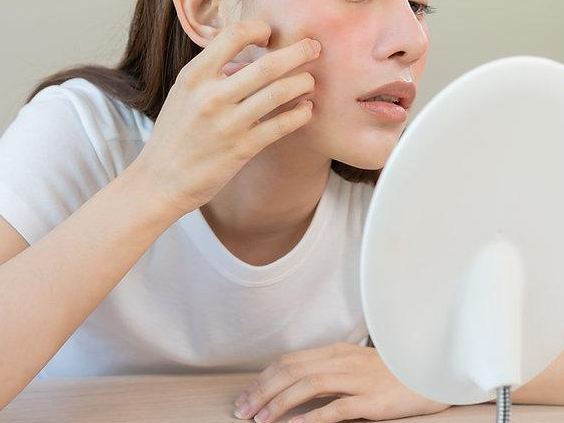
Temporary redness and warmth may occur after treatment, but these usually improve over time.
Although rare, temporary redness, swelling, and warmth may appear. Depending on the person, a burning sensation or tenderness may last for several days.
Side effects such as burns and pigmentation changes have also been reported, but considering energy settings and skin condition during treatment can help reduce the likelihood of these.
Closing thoughts
If you’ve been putting off lifting treatment because you’re afraid of titanium lifting pain, the key question isn’t “Does it hurt at all?” but “Will the medical team adjust the energy while monitoring my pain?”
Start by understanding your skin’s current condition, then consult with a specialist to determine which lifting treatment is right for you.
If you have any other questions, feel free to ask.




*This post was written directly by Pixellab Plastic Surgery for the purpose of providing medical information and promotion, in compliance with Article 56, Paragraph 1 of the Medical Service Act. All treatments and surgeries carry the possibility of side effects depending on the individual, so we strongly recommend making a decision only after thorough consultation with qualified medical professionals.
Frequently Asked Questions
Does titanium lifting really not hurt?
Pain is not completely absent; it is closer to manageable pain. The surface stays cool during treatment, but heat can build up under the skin and feel hot, and the degree varies from person to person.
Why does titanium lifting cause pain?
Titanium lifting tightens the skin by building heat in the retaining ligaments beneath the skin, so that heat can cause pain. It is described as a warm heat rising from within rather than a needle-like sting.
Can pain be adjusted during treatment if it becomes intense?
Yes. During treatment, the heat can be monitored and the energy level, speed, and treatment area adjusted immediately. If it gets too hot, the energy can be lowered or the handpiece moved faster. Rather than eliminating pain altogether, adjustments are made within a range that still delivers the necessary energy.
When is titanium lifting not recommended?
In the following cases, treatment is usually postponed or another option is recommended first: people with very little facial fat who may feel intense bone sensation, or people undergoing orthodontic treatment who may experience significant jaw sensitivity. Other cases include those who expect no pain at all, or whose condition or skin on the day is not suitable.
Are there any aftercare precautions after titanium lifting?
Yes. For 1–2 days after treatment, it is recommended to avoid heat stimulation and take care to keep the skin moisturized. Your face may feel warm and look slightly red, but this usually subsides within a day or two. On the day of treatment, it is best to avoid activities that raise body heat, such as saunas, intense exercise, and alcohol.
Are there side effects of titanium lifting?
Yes. Although rare, temporary redness, swelling, and warmth may occur, and these usually improve over time. Cases of burns and pigmentation changes have also been reported, but considering energy settings and skin condition can help lower the likelihood of these.