2026-11-09
What You Need to Know Before Consulting About MetaCell: Differences from PRP, Autologous Exosomes, and Stem Cell IV Drips
A clear guide to how MetaCell differs from PRP, autologous exosomes, and stem cell IV drips, and how Pixel Lab designs its full program around the activation process.

The more you look into MetaCell, the more confusing it gets how it differs from stem cell IV drips, exosome injections, and PRP, right?
It is related to all three, but it is hard to group it under any one of them.
That's because MetaCell is closer to a technology that "awakens" the regenerative signals in your own blood and cells using light and temperature.
Hello, I'm Dr. Song Jong-geun, director of Pixel Lab Plastic Surgery in Sinnonhyeon.
As a board-certified plastic surgeon, I have personally operated the MetaCell device since September 2025. Rather than limiting MetaCell to a simple injection, I have developed it into an integrated program that combines hyperbaric oxygen therapy, NAD+ preconditioning, two-stage PRF and MetaCell activation, and a four-color IV drip series.
In the consultation room, I often hear questions like:
"Is MetaCell a stem cell IV drip or an exosome injection?",
"Is PRP the same as stem cells?"
Many people ask me exactly these questions.
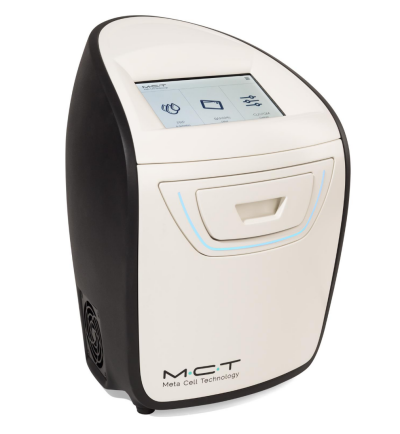
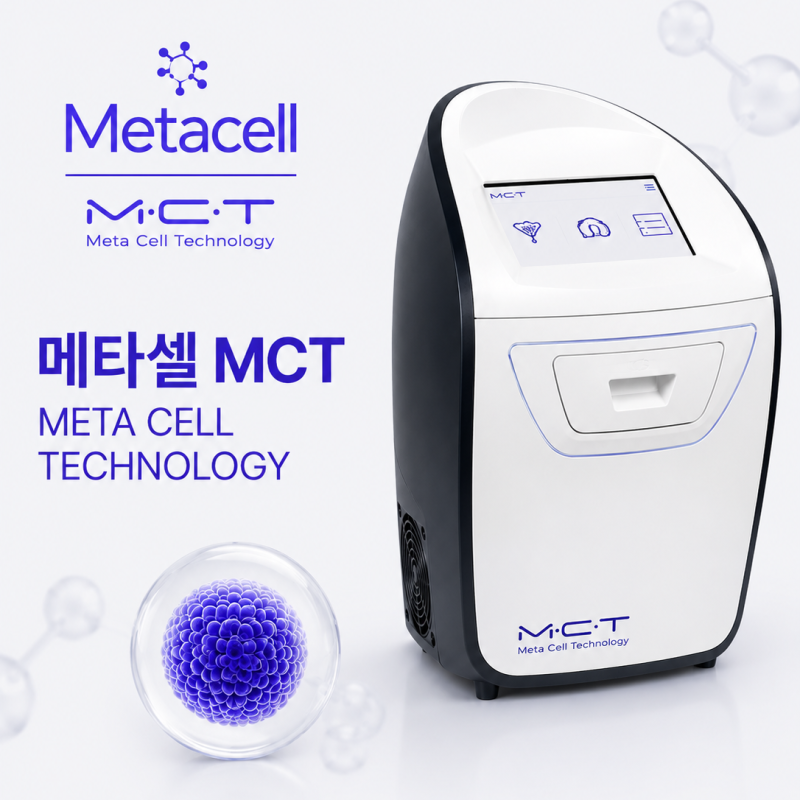
The MCT (Meta Cell Technology) device, a white unit with a touchscreen on top.
In this post, I'll walk you through what MetaCell actually is and how it differs from stem cell IV drips, exosomes, and PRP, starting with the treatment principle.
To understand the concept properly, it helps to start with the treatment principle, right? Let's work through them one at a time, in order.
If you search online, MetaCell is often lumped together with stem cell IV drips, exosome injections, and PRP.
It's true that it is related to all three. To be precise about the conceptual difference, MetaCell is not about 'what goes in,' but about 'how your own components are awakened.'
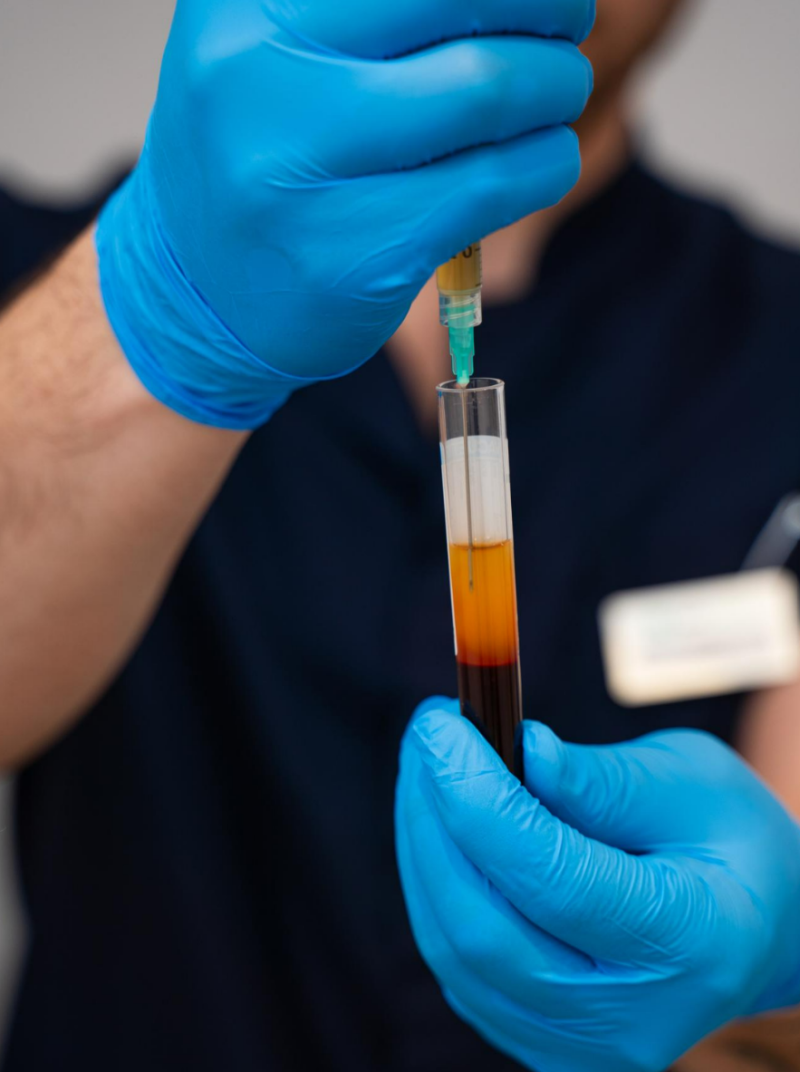
Gloved hands drawing the separated yellow plasma layer from a blood tube with a syringe.
MetaCell is not a 'product' but an 'activation system'
MetaCell (MCT) is a system that processes PRP or cell components obtained from your own blood with light and temperature tailored to the goal. It isn't the name of a specific product made elsewhere. It's closer to a technology that awakens your own components so they release growth factors, ATP (an energy molecule cells use), and autologous exosomes more actively.
Looking at the process step by step:
The drawn blood is separated into its components,
activated once with PRF (primary physical activation),
then activated once more using the five light and temperature settings of the MetaCell device (secondary activation),
and applied to the skin or into a vein.
Because it regulates cell activity with light, MetaCell is also called "photobiomodulation" (the principle of regulating cell activity with light).
How is MetaCell different from stem cell IV drips, exosomes, and PRP?
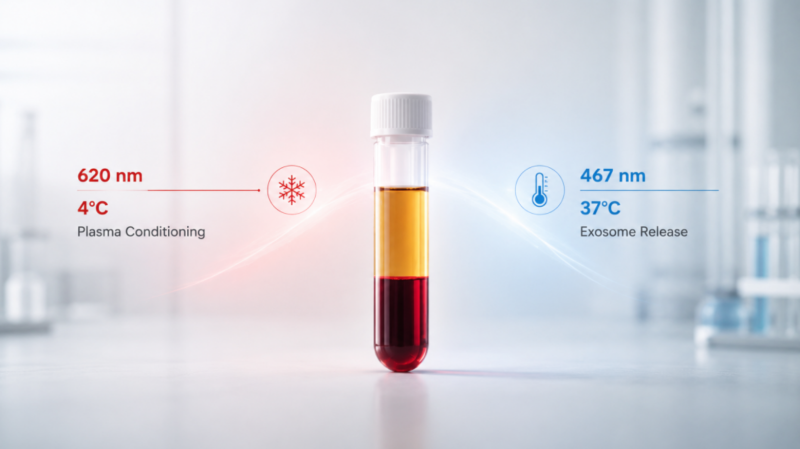
Blood tube diagram: 620 nm light at 4°C for plasma conditioning and 467 nm at 37°C for exosome release.
Category | Key Concept |
Standard PRP | A step that concentrates the regenerative components of your own blood |
Autologous exosomes | Tiny carriers released from your own platelets that transmit repair signals between cells |
Stem cell IV drip | A method of delivering prepared autologous components to cells or through a vein. |
MetaCell (MCT) | An activation technology that awakens these components twice: first with PRF (physical activation), then with light and temperature. It is run in two modes, Exosome mode and CELL mode. |
Put simply, if standard PRP is the step of collecting components, MetaCell is a two-stage activation process: the collected components are first activated physically with PRF, then activated once more with light and temperature.
Rather than just collecting components and injecting them, it applies physical and optical stimulation in sequence.
MetaCell operates in two modes depending on the goal. Exosome mode awakens the regenerative signaling molecules in your blood to enrich skin repair signals, while CELL mode boosts cellular energy and growth factor response to raise the regenerative environment itself. So even with the same MetaCell, the mode changes depending on what you aim for.
In other words, it uses optical stimulation instead of chemical activators.
That's why, in consultations, I explain MetaCell as the "technology" and stem cell IV drips as the "method of applying that technology."
Beyond the difference between MetaCell and stem cell IV drips,
if you're also curious about the same-day principle that requires no culturing process,
you can find more detail in the post below.
▼
How are autologous exosomes different from external exosomes?

Many exosome products on the market are ingredients manufactured externally.
In contrast, autologous exosomes are carriers that come from your own body. They utilize the regenerative signals of autologous components derived from your own platelets.

In other words, because it does not simply inject external ingredients, the approach can aim to reduce the risk of foreign-body and immune reactions compared with externally derived components.
That said, even though they are autologous, bruising, swelling, or infection cannot be ruled out entirely. That's why I explain these points thoroughly before the procedure.
Pixel Lab's key principle is to look first at the 'before injection' stage
Having covered the principles, let's now look at the key points of the procedure as Pixel Lab sees them.
Put simply, it's about 'focusing on the body's condition before the procedure.'
At Pixel Lab, the basic flow is:
Hyperbaric oxygen → Blood draw → PRF physical activation (1st) → MetaCell light activation (2nd) → Four-color IV drip (NAD+ solution → Red (MetaCell) + Yellow and Pink solutions) |
We carry out the procedure in this order.
First, hyperbaric oxygen and NAD+ infusion prepare the environment in advance so the body can better accept the components (preconditioning: the step of preparing the body before the components are introduced).
Next, the drawn blood is activated once with PRF (physical activation) and once more with the light and temperature of the MetaCell device (light activation).
In the four-color IV drip stage, the twice-activated components are administered as follows: NAD+ solution first, followed by the activated red (MetaCell) solution together with the yellow and pink solutions.
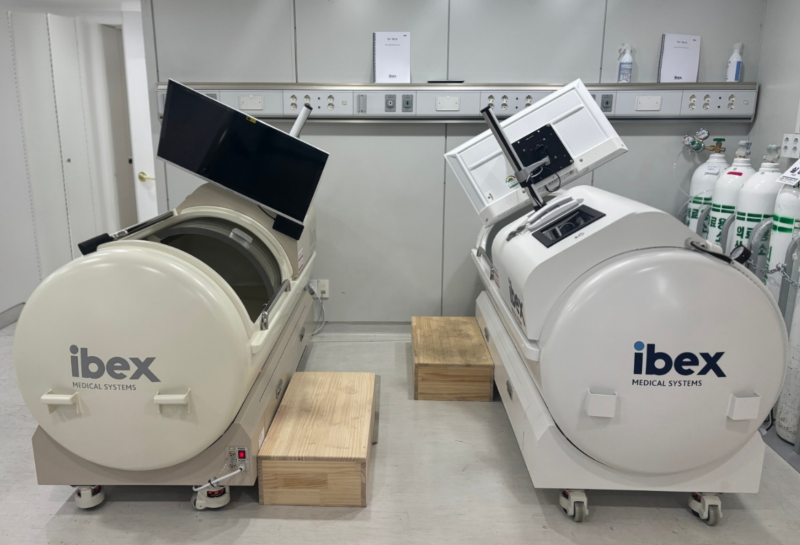
Two ibex Medical Systems hyperbaric chambers side by side in a treatment room with oxygen tanks.
Hyperbaric oxygen fully saturates the body with oxygen,
after blood collection and separation,
NAD+ infusion prepares the energy metabolism environment in which cells can do their work.
Once the environment is prepared, we move on to administering MetaCell and the necessary IV solutions.
In other words, we believe that creating an environment where the body can accept the components before introducing the cells leads to better results.
Final step: how is the four-color IV drip composed?
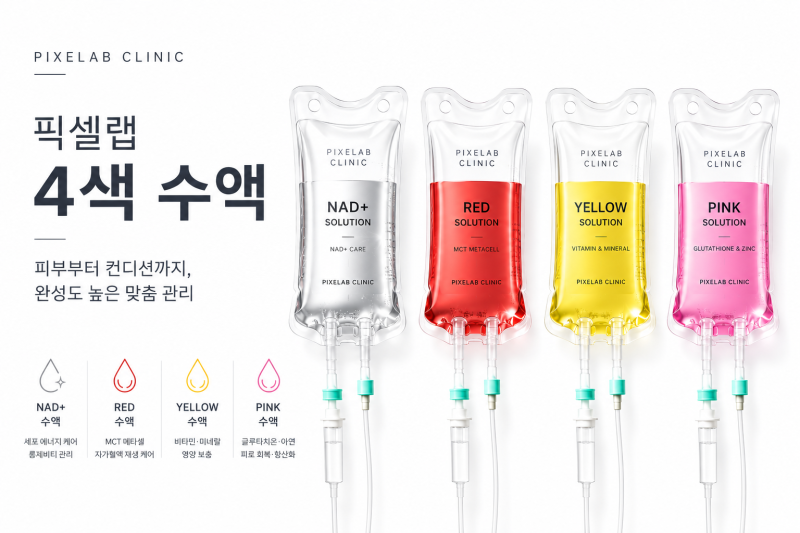
Once activation is complete, the session is finished with Pixel Lab's four-color IV drip. Each color plays a different role.
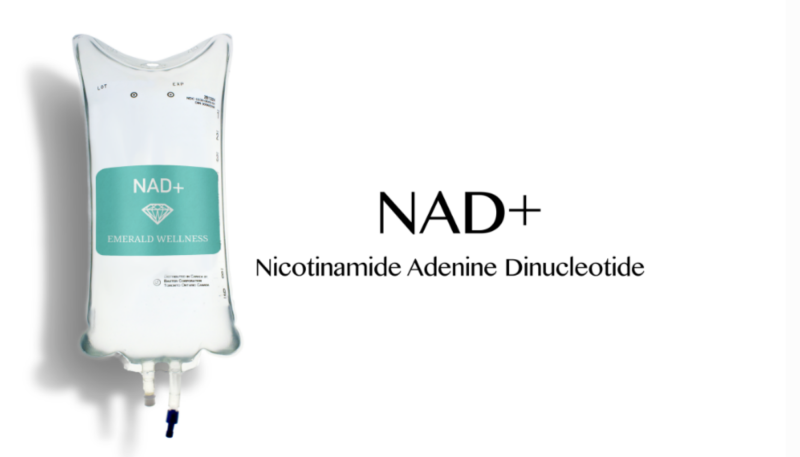
NAD+ solution (first) — an ingredient related to cellular energy metabolism. It has drawn attention recently in longevity (healthspan) management, so it is included in formulations aimed at overall wellness and anti-aging. It is administered first.
Red solution — the core ingredient made from your own blood after the MetaCell process, and the central step of this package.
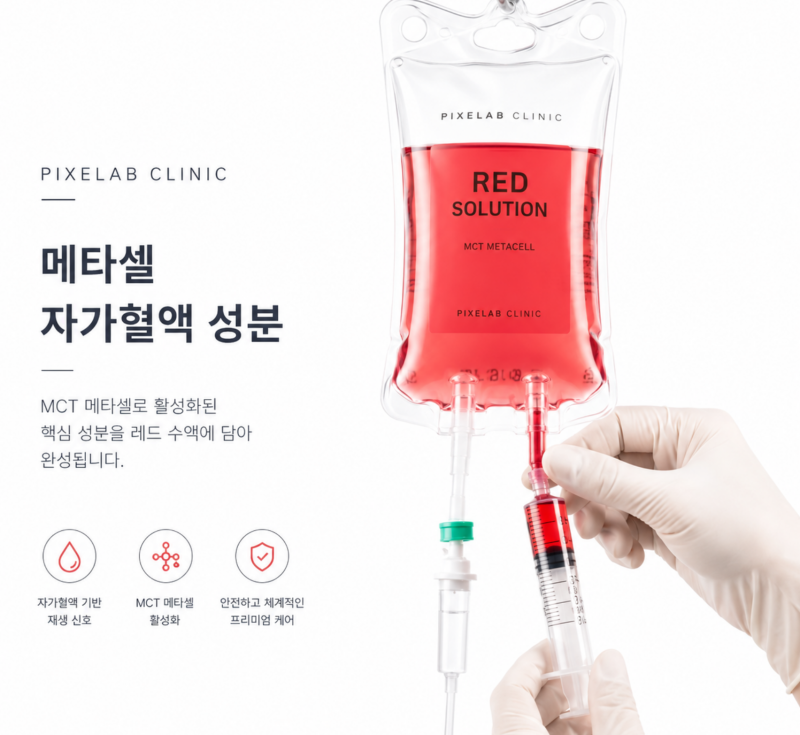
Pixelab Clinic's Metacell autologous blood IV: key components activated by MCT Metacell are added to the Red Solution drip.
Yellow and pink solutions — vitamin-, glutathione-, and zinc-based ingredients that help with basic fatigue recovery and nutritional support. They are administered together with the red solution.
Who might benefit from MetaCell?
MetaCell MCT is divided into two types depending on how it is applied.
The skin booster version, applied to the skin, directly delivers the regenerative signals in your own blood to the skin.
The IV version, which is what I'm discussing today, targets overall body condition rather than localized skin areas, so I typically recommend it to people like the following:
People in their 30s to 40s who feel exhausted even after sleeping and often work late or attend work dinners
Those who feel the effects of regular IV drips wear off quickly
Those who feel their recovery has slowed down after their 40s
Those interested in longevity, anti-aging, or overall wellness management
It's best understood less as boosting already good condition and more as refilling a depleted state. Pouring water into a cracked jar drains it quickly, whereas MetaCell is closer to strengthening the jar itself.
Frequently Asked Questions
Q. Is MetaCell a stem cell IV drip?

No. MetaCell is a "technology" that activates components with light and temperature, while a stem cell IV drip is the "method" of delivering those components to cells or through a vein. MetaCell is run in Exosome or CELL mode depending on the goal. The mode used simply varies by program, but MetaCell and stem cell IV drips are not the same thing.
Q. Is it the same as getting an exosome injection?

Unlike an injection of externally manufactured exosomes, MetaCell is closer to awakening your own platelets so they release autologous exosomes. The biggest difference is that it doesn't simply inject external ingredients; it uses regenerative signals that come from your own body.
Q. How is it different from regular PRP?
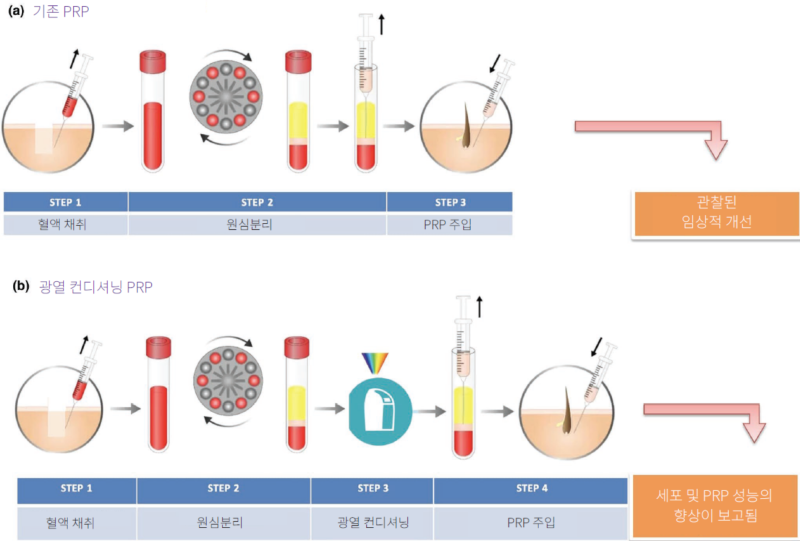
Where standard PRP is the step of concentrating components, MetaCell differs in that it activates those components once more with light and temperature. Once activated, regenerative signals such as growth factors, ATP, and autologous exosomes are released more actively. In other words, the skin has more room to respond to these signals.
It's the difference between simply collecting components and injecting them, versus awakening those components before injecting them.
To sum up, MetaCell may sound like a single injection by name, but in reality it is a technology designed around how to awaken and use the signals in your own blood and cells.
Pixel Lab links this with hyperbaric oxygen, NAD+ infusion preconditioning, and post-treatment recovery care, designing the entire process as one program rather than a simple injection.
That's why, even with the same MetaCell, the program can feel very different depending on pre-treatment, mode, administration method, and recovery care. With that, I'll wrap up today's discussion.




*This post was written directly by Pixel Lab Plastic Surgery Clinic for the purpose of providing medical information and promotion, in compliance with Article 56, Paragraph 1 of the Medical Service Act. All treatments and surgeries carry a possibility of side effects that vary by individual, so we recommend making a decision only after thorough consultation with qualified medical professionals.
#MetaCell #AutologousExosome #PRP #StemCellIV #MCT #Preconditioning #SinnonhyeonSkin